Business Roundtable that I wish had something to do with Pizza.

The business group, Business Roundtable issued a press release on Monday, August 19, 2019, saying they were redefining the purposes of a corporation to promote an economy that serves all Americans.

Business Roundtable, from their website: “is an association of chief executive officers of America’s leading companies working to promote a thriving U.S. economy and expanded opportunity for all Americans through sound public policy…. Business Roundtable exclusively represents chief executive officers (CEOs) of America’s leading companies. These CEO members lead companies with more than 15 million employees and more than $7 trillion in annual revenues.”

Their full statement is: here. I encourage you to read it first and make your own determination. I first came about it on a linkedin post by my friend Ben Narodick. Ben wasn’t a fan, and I can’t really say I am either.

This blog is focused on employees and their compensation, which was addressed in the Roundtable’s press release. The second of their five commitments in the letter:

Investing in our employees. This starts with compensating them fairly and providing important benefits….” – Business Roundtable.

I don’t think that’s really saying a whole lot. Would they instead have said they were going to dis-invest from their employees? Compensate them unfairly? Take away benefits? Words matter, and as Ben pointed out, they’re really not using meaningful words. This is how I think it could have been more meaningful:

Investing in our employees. This starts with compensating them MORE and providing important benefits, INCLUDING HEALTH INSURANCE WITH REASONABLE PREMIUMS AND DEDUCTIBLES, RETIREMENT, AND PAID TIME OFF.” – Anxious AF

But they didn’t say that – so it’s near impossible to actually measure whether or not the members of the Business Roundtable are actually improving their behavior in the way they want inferred.

181 CEOs “signed” the new Statement on the Purpose of a Corporation. And you know what I can add to this conversation? Spending time looking at financial statements. So this may be a running post series, but here some compensation details about the first five signatories.

NUMBER ONE: Kevin J. Wheeler. President and CEO of the A.O. Smith Corporation. From the company’s 2019 10K proxy filing. In 2018, Mr. Wheeler’s total compensation was $ 3,872,974 . That’s 200 times their median salary employee of just over $19K/year (or less than $10/hour for full-time work). Side note, Mr. Wheeler gets a $40,000 “allowance” (twice their median salary). He was also not the highest paid employee at AO. That was Executive Chairman Ajita G. Rajendra, who made $6,790,412.

NUMBER TWO: Miles D. White. Chairman and CEO of Abbott. Per their proxy filing from March 2019, Mr. White made over $24M in 2018. Abbott reports its median employee income as just over $80,000; bringing the CEO pay ratio to 301 to 1.

NUMBER THREE: Julie Sweet, CEO Designee of Accenture. Ms. Sweet made almost $5.9 Million in 2018, as the North American CEO. Pierre Nanterme, the organization’s CEO made over $22M in 2018. Per their proxy, Accenture’s median employee made just over $40,000 in 2018; giving them a CEO pay ratio of 555:1.

NUMBER FOUR: Carlos Rodriguez, President and CEO of ADP. $12M in 2018. Median Employee: just under $60,000. Ratio: 211:1. Here’s their proxy.

AND NUMBER FIVE: Michael Burke, Chairman and CEO of Aecom. $15.6Million in 2018. Median employee made $78,516. Ratio: 200:1. Here’s that proxy.

For those of you playing at home, you can refer back to my first post, wherein I arrived at a high x80 ratio that one might expect from the highest paid executive at any company. All of these companies are well above that – at least double.

In summary: the worst offender so far: ACCENTURE (x555). The “best” (?) offender? I’ll skip AO Smith, given their particularly low median income, and go with Aecom (x200).

I don’t know about you, but I can’t WAIT to see what the rest of the list brings.

Pay your people and put your money where your mouth is,
The Anxious Amateur Economist
UBER Employee Underpayment

The ride-sharing app/company, Uber, went public in May (2019). If you’ve never used the app/service, Uber is essentially a taxi service (1) you hail through an app on your phone; (2) through which anyone can sign up to be a driver, using their own personal vehicle; and (3) that you pay for through your phone app at the end of each trip. Uber takes their cut from that payment and then pays the driver.

After its initial public offering (IPO), Uber mostly made the news for taking a huge hit/loss in the stock market. From that New York Time’s article, Uber lost the most in dollar terms at its initial public offering than any company since 1975.

There are several aspects of Uber that make it particularly odd:
1. The Books. They don’t use generally accepted accounting principles (GAAP) when presenting their financials. (Refer to page 29 of their IPO prospectus.) GAAP makes companies more comparable – 8 apples vs 11 apples. I wonder why Uber uses accounting principles that don’t allow the public to compare them easily to other companies?
2. The Performance. Even using their non-GAAP treatment, they still reported $1.8 billion in 2018. Sorry…that’s $1.8 billion in LOSSES, not profit. (Page 31 of the prospectus.) (See special note below.*)
3. The CEO. Notwithstanding the $1.8B loss, they paid their CEO $45 million in 2018. (Page 240 of the prospectus. )
4. The Workers. They have just over 22 thousand employees (pg. 29), but 3.9 million drivers (Pg. 5). Their actual 40-hour/week employees just constitute less than 1% (0.56%) of their workforce. Put another way, drivers – who have no commitment by the company to ever make any money and can be dropped at any time, without severance – make up over 99% of their workforce.
5. Driver Payment. This requires some math because they don’t come right out and say how much their drivers actually make. They disclose that “gross bookings” were just under $50 billion in 2018 (pg. 5). When you divide that by 3.9 million drivers? That’s just $12,820 per driver. Granted, I think it’s safe to assume drivers generally don’t work 40 hour weeks and mostly use Uber as a side gig, but if they did, that’s just $6.40/hour ($12.80/hour for a 20-hour week).

My thesis: Uber, while paying its top executives insane amounts of money, is completely dependent on a workforce who accepts wages at around the minimum wage. They’re a taxi service that doesn’t pay taxi driver wages.

There are better articles on what drivers actually make. The hyperlinked article concludes it can be around $25/hour in bigger cities, but that’s not for a 40-hour week. Even then – the article pointed this out before I thought about – by not being employees, drivers also then have to shoulder a lot of costs that employees don’t, such as their health insurance and car payments. The article also concludes that with drivers bringing their own vehicle (asset) into the company, Uber has a $4 billion fleet of vehicles it has not paid a dime for.

I stopped using Uber over a year ago. I’d use Lyft if I’m in a pinch, but never more than once a month. It’s convenient. Cheaper than a taxi. But it comes at a cost. And there’s conflict with that. It’s a way for some people to make money (kind of), but I don’t want to feed into that cycle of underpaying my neighbors who drive for Uber so that rich executives can get richer.

(*Special note. My wife asked a good question when she proofed this – why such a big loss ($1.8 billion)? On that same table, they note almost $5 billion in “Other expenses.” Referring to page 95, footnote (f), I read as saying they had to pay over $3 billion in taxes in Russia and Southeast Asia when they sold their operations to buy non-controlling shares in the resulting entity (plus another $40 million to their accountants and lawyers (footnote (e)).)

Taxis are expensive – to me at least. But maybe that cost represents the true value of a taxi ride, where the driver actually gets paid what they deserve.

Pay your people,
The Anxious, Amateur Economist.

Video Games, Delta and Unions

I’m a man who loves video games. I played the original Warcraft and Command & Conquer video games on PC, Halo on XBox and Mario Kart on Nintendo 64. If you talk to my wife, you might even think I have a “pRoBLem.” But I’m cost conscious. (I love a good Steam sale.) Apparently Delta Airlines thinks it’s employees are, too, as Delta ran anti-union posters, saying the $700 annual union dues was better spent on video games.

I don’t belong to a union. My chosen profession – unless you work for the feds, state or a city, you don’t really have the chance to join a union. But full disclosure, I consider myself a “union guy,” as both my parents and a large number of my relatives are and were members of their union. I attribute my relatively privileged upbringing to luck, my parent’s luck, my parent’s hard work, and the fact that they belonged to unions.

What do unions do? They give workers bargaining power. For example, if one worker threatens to quit because they don’t get $1/hour raise, no big deal; but if 50%+ of your workforce decides to quit, that would be a significant issue for any employer. But for any one employee, that one job means a lot. Compare this kind of power this to an employer – where any one employee is rarely irreplaceable. Particularly today, companies get a huge number of applicants for any one job, making it easier for them to pay any one position less money.

So let’s look at the case for Delta by diving into their latest 10-K and proxy.

From Page 51 of their 2018 Proxy: Delta’s median employee made $81,355. Not bad – just over $40 an hour. Granted, that is just the median – half of their employees make less than that.

What about Delta’s CEO, Ed Bastian? In that same year, Mr. Bastian made $14,982,448, or 184 times their median employee. Put another way – he made Delta’s median employee’s wages in just two days of work.

What about their other executives?
Delta’s President, Glen Hauenstein, made $8.4M in 2018 (Page 41 of the Proxy);
Delta’s Chief Operating Officer, W. Gil West, also made $8.4M in 2018;
Delta’s Chief Financial Officer, Paul Jacobson, made $5.7M; and
Delta’s Chief Legal Officer, Peter Carter, made just $4.1M.

So, being against a union, I’m sure Delta must be hurting financially, right? Particularly after compensating their executives so well?

In 2018, Delta’s profits were $3.9 Billion (page 54 of their 10-K) and paid $909 Million to its shareholders (that’s dividends (CASH MONEY), not the increase in market capitalization, page 56 of their 10-K).

So what would, say a $6K/year raise for the bottom half (under the median) of its employees look like?

Per Page 10 of their 10-K, Delta had 89,000 employees in 2018.
Half of that is 44,500 employees.
Times the $6K raise, equals $267,000,000.
Which still would leave $642 Million they could have still paid out to shareholders.

How terrible for Delta and its shareholders.

Pay your people,
The Anxious, Amateur Economist

Motivate Chase to STFU

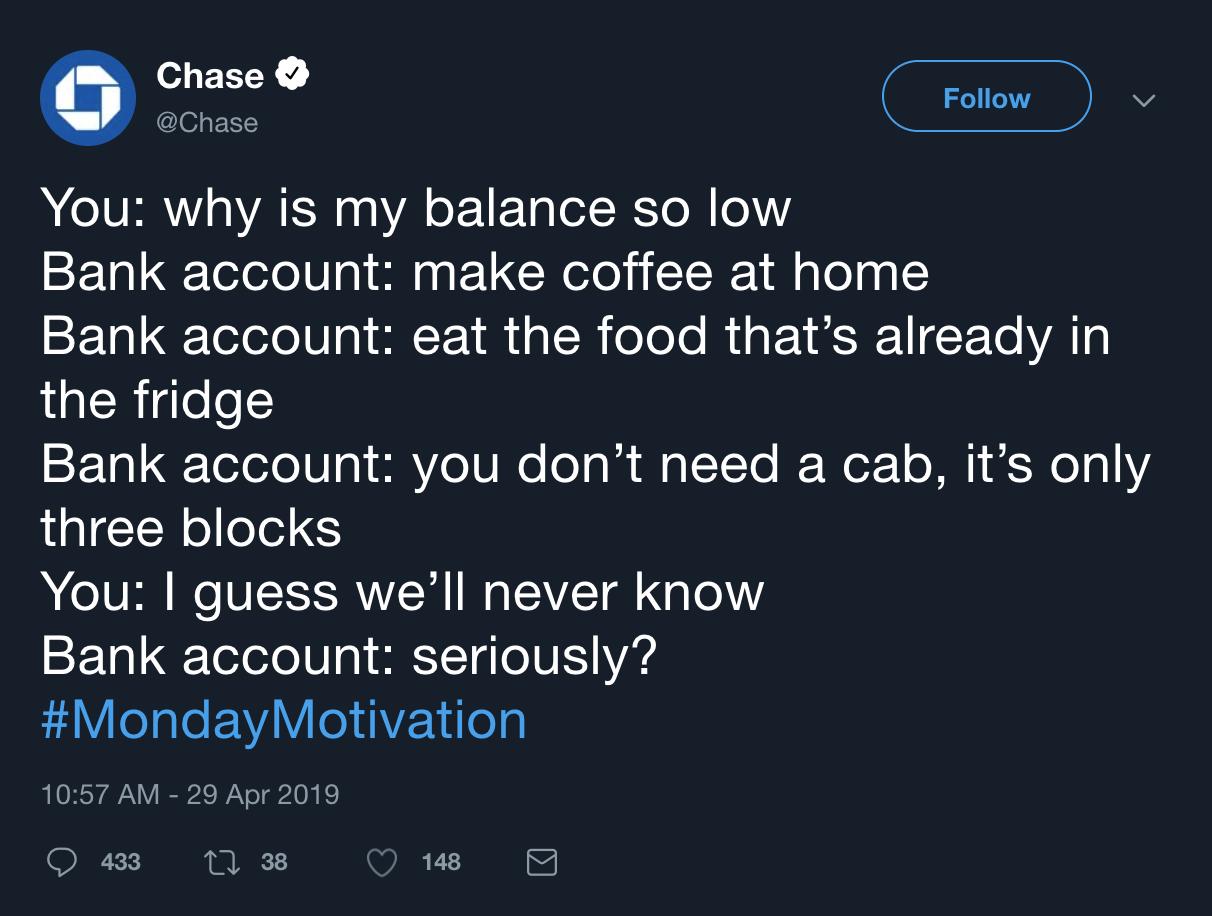
On Monday, April 29, 2019, Chase Bank’s twitter account posted this:

Unsurprisingly, I found this to be trash. I think it was incredibly tone deaf, particularly coming from a financial institution with outrageously paid executives and who contributed to the financial crisis when wages have been stagnant for the last 40 years.

JPMorgan Chase’s median employee made $78,923 in 2018 (page 75 of their latest proxy statement). That’s not too bad – roughly $39/hour. What about their executive team?

Per page 65 of the same proxy statement, Jamie Dimon, the CEO of JPMorgan Chase, made $30,033,745 in 2018. Their CEO-to-median employee pay ratio is reported as 1-to-381. Their other top executives, made $21M, $20M, $19M, and $14M.

And you know, I’m sure these executives know exactly what it’s like to manage personal finance on $78,923 a year.

THAT WAS SARCASM.

Jamie Dimon made their median employee’s salary IN LESS THAN A DAY.

I’m still working through this idea and want to research it more – the idea of how competitive it is to land an C-suite executive job at a Fortune 100 company. I think basic employment economics would suggest that such a high-paying job, where you could essentially work for one year and never have to work again (2% interest on $10M = $200K/year). But from what I can tell, when they look to fill these positions, there doesn’t appear to be a wide search for the best candidate, certainly not taking 250 resumes for one position, like other corporate positions.

But perhaps Mr. Dimon has shown particular skills and business acumen that would justify such a crazy compensation package. As I said in my first blog post, when you look at certain factors, it’s not difficult to justify kind of big numbers. Maybe Jamie really is that valuable. You know, as opposed to being the Chief Executive Officer when the firm suffered a loss that contributed to a nationwide recession and wage stagnation such that workers can’t really afford a cup of coffee or taxi. RIGHT?

Page 29 of JPMorgan Chase’s 2008 annual report. JPMorgan Chase wrote down (i.e., took a loss in) over $10,000,000,000 ($10 Billion) in mortgage-related positions, dropping their year-over-year profits by 66%. CEO at the time – Jamie Dimon. And yet, he still makes $30M a year.

Has JPMorgan and its shareholders ever looked at maybe finding someone who wouldn’t lose the company $10B. Do they would find someone who they could even get away with paying $7.5M (x100 the median employee)? I do.

Pay your people, just maybe not CEOs who lose $10B,
The Anxious, Amateur Economist


Thanksgiving, Millenials, and Home Buying

Two or three years ago, at Thanksgiving, a family friend asked my wife and I why we were looking at condominiums for our first home purchase instead of a house.

BECAUSE IT WAS TOO EXPENSIVE, PATRICIA (not her name).

Thanks to the internet and public records, it was relatively easy to look up information about her house. She bought her house, a three-bedroom, two-bathroom, in 1997, on the west side of Los Angeles, for just under $270,000.  I *knew* that there was no way my wife and I were facing the same housing market she was in 1997. In writing this post, I looked at the numbers for the first time.

  1. 1997’s $270,000 in 2019 dollars is $427,377. Not terribly different from what we end up paying for our condo (WHICH WE LOVE AND ARE VERY HAPPY WITH – THANKS FOR ASKING).
  2. The Zestimate (the real estate website, Zillow’s, estimated value of the property, i.e., a proxy for what that home would now sell for) is just under $1,300,000 (i.e., $870,000 more than what she bought it for).
  3. Whether or not you account for inflation, her house has increased in value between 5% and 7.4% each year.
  4. How have wages changed over that same time period? Just 3.7% (Federal Reserve of Atlanta, Weighted Average).  No indication whether or not this accounts for inflation.
  5. What has been the difference between her home value appreciation and wages over those 22 years? Depending on inflation accounting, wages have lagged between 43% and 258% over those 22 years.

So yeah, we didn’t a buy a house. Thanksgiving is great, isn’t it?

Pay your people PLEASE,
The Anxious, Amateur Economist